The 2026 Australian Social Policy Conference was held September 30 – October 2, 2026 at the University of Queensland in Brisbane, Australia. The conference provided a good overview of the research and initiatives happening in relation to social policy in Australia as well as other Asia-Pacific locations, and featured quite a few sessions relating to digital technologies and AI (including my own). Below is a selection of some of my notes from various sessions and links to further information. The conference program has a list of all the keynotes and parallel sessions.
I also enjoyed taking the ferry in to the conference (50 cent fares for public transport!) and getting to experience the sights and sounds of Brisbane since I hadn’t visited for a while. The Brisbane River is a beautiful feature of this city.

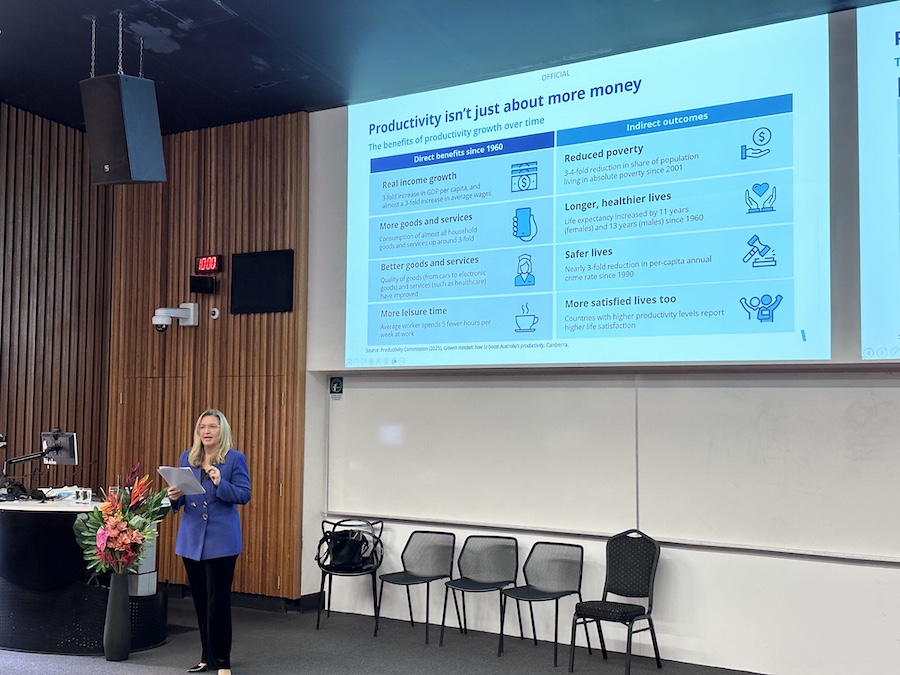
The Trust Dividend: Prevention & Australia’s Future by Dr. Angela Jackson – Social Policy Commissioner, Australian Government Productivity Commission
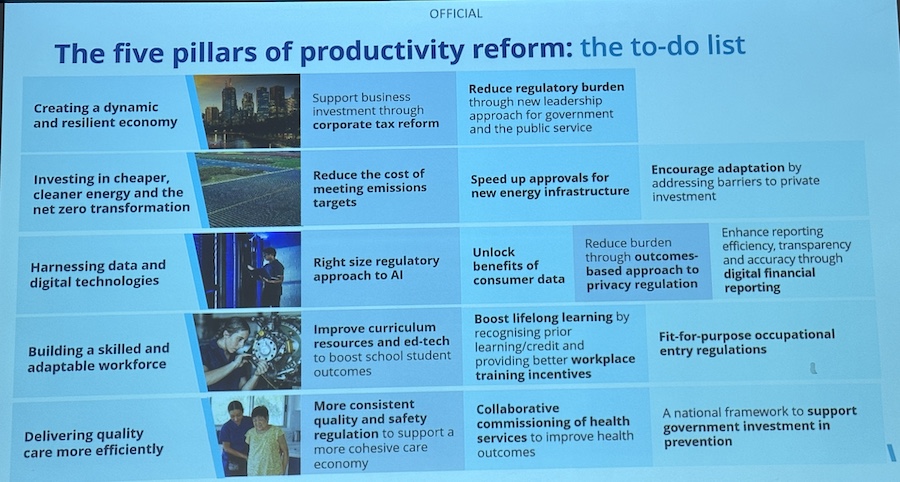
Dr. Jackson noted that economic policy is not separate from social policy (e.g. childcare can enable parents to work), and it’s not just about creating wealth and growth vs. distributing it. Productivity has an image problem; it’s seen as statistics in a spreadsheet. Trust is easier to maintain when people can see progress for themselves and their kids. The stats show that 59% of Australians feel life now in 2026 is worse than 50 years ago, up from 35% in 2020. The Commission is recommending a National Prevention & Early Prevention Framework to increase productivity and trust. Part of this framework is about turbocharging social policy through increasing data like linked data. Australia doesn’t have an official measure of poverty, and is one of the only OECD countries to not have one. Real-time data can improve accountability.
The Hon Tanya Plibersek MP, Minister for Social Services
Plibersek discussed funding for prevention and intervention; e.g. the Aboriginal Community Controlled Health organizations have really good outcomes. She noted the need to use big systems we already have like universities to recognize the signs of domestic violence. New South Wales used an example from New Zealand as a guide: a social investment model that tracked around 100 disadvantaged families (especially young women with children) to see the avoided costs of early intervention. She said the work of the people at the conference does make a difference and filters into policy. There is a need to get better at having a data loop to get the evaluation of data by the government back to the community faster, and a need for long-term datasets showing bad things decreasing and good things increasing. Basically, we need data on what programs got both right and wrong.
Stream: Digital Technology in Welfare and Support
Digital System Abuse: Gendered Violence and the Datafication of Welfare – Dr. Lyndal Sleep
Dr. Sleep discussed the challenge in finding evidence for digital system abuse due to the black box nature of digital systems and gave three examples. 1. A tip-off line: perpetrators can weaponize welfare administrative systems, e.g. by threatening to inform on their partner for non-compliance. 2. Underreporting or non-disclosure of information in online forms: A perpetrator can deliberately not disclose or underreport a partner’s income into an online system, meaning the victim can later incur a debt if the underreporting is discovered. Even if she can get it waived, she has to go through the burden of the process. 3. The compliance system itself: the #NotMyDebt website showed how welfare compliance was mirroring perpetrators’ interactive tactics of abuse like gaslighting, threats, and abusive phone calls.
Making the Unemployed: How Digital Data Infrastructure Manufactures the Case for Activation – Ray Griffin (presenting), Aisling Tuite, Antoinette Jordan
Griffin made the point that welfare systems have always been digital (binary): you either qualify or you don’t, even if this was done on paper. An issue is that we can’t study digital service development like we can with a human developed service. With digital services, it’s a developer writing code and a modeling system. When a case worker sees a person (jobseeker), they already know something about them from a system they can’t override, like an assigned number, even if there’s a human in the loop, etc. Human wayfinding produces better outcomes for claimants than an automated first-instance decision. A person is molded to be one thing: e.g. they are someone who neatly ticks a box for being one thing on a form, someone who has technological literacy and knows how to do multi-factor authentication (MFA), but actually humans are more complex. A key issue is that encoded in these systems is the worldview of the people who made them.
The Ethics of Social Security Debt Recovery: Learning from Robodebt – Dr. Katherine Curchin
Dr. Curchin covered the Australian scandal called Robodebt and her question was: what are the ethical constraints to consider when the government is looking to collect overpayments. Robodebt started in 2015-2016. It was promised to take less time (20k cases, up to $20k/week) and result in a lot of recovered funds ($1.7 bil over 5 years). Scott Morrison, then Minister for Social Services, championed it. In the end, the program resulted in $720 million of unlawfully recovered debt and triggered the biggest class action lawsuit in Australia. 400,000 individuals received compensation and there was a lot of shame in the whole program. Similar programs include MIDAS (Michigan), Concentrix scandal (UK), and Carer’s Allowance scandal (UK).
In the Q&A for the session, a question was asked about digital systems distancing people from the system & decisions. The presenters discussed how lots of governments and states can’t make a coherent digital system and this low capability can have an upside that means states don’t make as much advancement in potentially harmful digital systems. The idea is that we have to build technologies differently and avoid the biases in tech. It’s not to say that tech can’t be useful; there is potential for digital systems to avoid some of the issues with the usual power imbalance between a case worker and a person seeking help. One example of how to make a digital system more user-friendly is when you have a long online form with dozens of questions, first let people see the whole form and download it so they can review how they want to respond and see what the ending says so they can choose how to present themselves. A page-by-page linear format doesn’t let them have all of the information up front or know how best to answer the questions. It was noted that AI will just become the new battleground for welfare.
Panel Discussion: Prioritising First-Hand Experience – Social Policy Up Close
A lively panel discussion on poverty included compelling statements such as: Don’t just extract info about poverty from us; we are the experts on poverty, we live it every day. I’d like the Defense Department to hold lamington sales for their funding. We overintellectualize these things; we know what works, e.g. Easy Read is clear; you can’t BS with that type of material. These are not wicked problems; we made them and can change them; we are humans; we can do it!
Stream – Social Justice in Education
Benevolent Segregation: Removing Children Instead of Removing Barriers to Inclusive Education – Jolienne Baasch
Baasch is researching the significant increase in withdrawn students from the NAPLAN literacy and numeracy test for Australians and whether ‘benevolent segregation’ of students such as those with autism spectrum disorder is occurring.
Examining Inequalities in Educational Experiences and Outcomes Using Agent-Based Modelling – Emma Knight (presenting), Tegan Cruwys, Joanne Rathbone, Paul Campbell, Veronica Sheanoda, Kate Reynolds
Knight discussed the development of an agent-based modelling platform covering how students’ psychosocial experiences affect their wellbeing as part of a research partnership between ANU and the ACT Government to progress the ACT Wellbeing Framework. It models the final years of high school (ages 15-18) using linked data and longitudinal data. There is an accessible user interface on the front end where things can be toggled off and on, and it can be used to compare intervention settings and alternative interventions. It’s available on request in the CoMSES Net Computational Model Library.
From Parity to Sovereignty: Reframing Justice Claims in SDG 4 Education Governance – Daeul Jeong
Jeong considered how we can analyze institutional inequalities and colonial relations underpinning them, looking at the UN’s Sustainable Development Goal (SDG) number 4 which promises education for all but then controls via language, testing, etc. Jeong uses Rigney & Fraser as theoretical lenses to analyze SDG4 and suggested one way to balance things: keep the raw community data in Indigenous control and only report on the data required for reporting.
The Quiet Drift from Decency – Restoring Humanity, Relationship and Moral Courage to Australian Social Policy – Dr Chris Sarra (Chair and Founder, Stronger Smarter Institute)
Policy is not just technical; it’s where institutional power meets a human life. We should not diminish the discontent around unaffordable housing, food, etc., and we should listen to it, but we shouldn’t let it be used to sow resentment and turn Australians against each other and cause division. This would be the exploitation of human anxiety, not decency, but it’s not just about one political party. We should listen to people’s anger and respond with policy that is competent and decent. It’s concerning when the government’s category becomes more compelling than curiosity about the people within it (e.g. in a discussion about closing the gap for Aboriginal people with frameworks & strategies, when he tried to open the door to what Aboriginal people themselves were discussing, no one in the room wanted to hear it). The example of Robodebt shows that this kind of situation was not created by a machine that turned malevolent, but by human beings at every stage; they weren’t cruel but let the institution override moral decency. Leaders set the tone for what is considered important, whether that is deadlines, or deficit thinking, or giving time for decent things like proper consultation before policy architecture is set. Everyone should ask themselves at every level of an organization: how is this going to manifest when it touches a person? If this were my own family, would it be acceptable?
The Tech Vacuum: Mapping New Zealand’s Digital and AI Literacy Policy Gaps – Dr Kara Kennedy
This was my session on the history and data behind the digital divide in New Zealand, various attempts to do something about it, and the lack of policies and resourcing to progress closing the gaps. I also discussed the emerging AI divide and how the government’s ‘light-touch’ approach to generative AI is not working and risks further entrenching people and society falling behind (for example by asking each school to make their own AI policy!).
A Trauma-Informed Framework for Digital Social Policy Analysis: Insights from Building a Trauma-Informed Assessment Tool for AI-Assisted Social Services – Lyndal Sleep and Angela Elvery (presenting), Suvradip Maitra, Awais Hameed Khan, Suzanna Fay
The Trauma-Informed AI Assessment Toolkit has the goal of helping people consider how to use AI in a way that takes into account a trauma-informed approach. It has different forms including an online version, a paper version, a design card version, and a board game version. Service users need a safe digital environment, and this means we need AI system designers, developers, and professionals to learn about trauma, while support workers need to learn about AI systems and have a baseline AI literacy.
Stream: Digital Governance and Infrastructure
Corporate Responsibility in Digital Risk Governance: Rethinking Australia’s Age-Based Social Media Restrictions – Laurensia Andrini
Andrini discussed the age checks being implemented in certain countries, including Australia, for social media bans, and how age checks as a mechanism to solve digital risk potentially create another risk relating to privacy and data protection and algorithmic bias. On the one hand, not making a government ID the sole verification method is beneficial for document-light individuals, but how much can we trust Corporate Digital Responsibility initiatives from tech companies, and what are the alternatives?
The ‘Infrastructuring’ of Digital Public Infrastructure in India: The Role and Influence of Non-State Actors – Suvradip Maitra
Maitra introduced India’s Digital Public Infrastructure (DPI) and its three elements: Digital ID: Aadhaar national biometric ID system, Digital Payments: instant payment network for phones to send/receive money, and Data Sharing: Digilocker & Account Aggregator that allow people to share personal data on banking, health, and identity. There has been significant involvement by non-state actors (e.g. think tanks, private organizations) in governing DPI but limited understanding of how they are shaping the design, implementation, and maintenance of it. It is being used as a global model, e.g. by World Bank in other developing countries. It is seen as a type of “railroad”, where the government funds infrastructure that private companies then build services off on (trains). Books to learn more on the topic are The Making of Aadhaar: The World’s Largest ID Platform and India’s Techade [affiliate links].
Stream: Labor & Employment
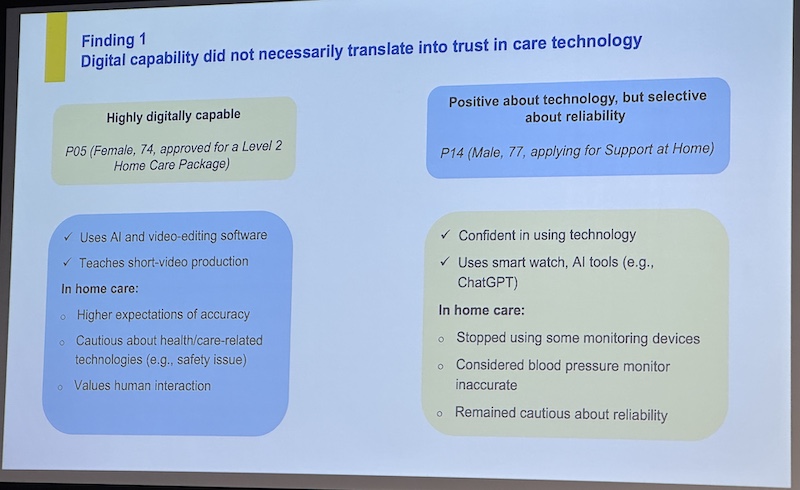
Engagement with Digital Technology in Home Care Settings: Experiences of Older Migrants in Australia – Lili Shang (presenting), Ilan Katz, Megan Blaxland, Bingqin Li
This project is looking at how older Chinese immigrants in Sydney perceive and engage with digital technologies in home care contexts. What shaped trust for them included accuracy and reliability of the technologies. There was an uneven access pathway: some had family help getting devices, while others had care workers suggest and explain tech. An interesting finding was that a participant said they feel uneasy about outsiders coming into their home and would prefer having technologies like robots.
Stream: Poverty and Health
‘Thread Help[s] Me Get Clean Clothes’: Addressing Clothing Poverty Through a Charity-Based Circular Economy of Fashion – Ana Stevenson (presenting), Rose-Marie Stambe, Jason Fernandez, Sarah Marris, Paula Lewis, Leanne Wood
Stevenson discussed the Thread Together program which keeps unsold clothing out of landfill by partnering fashion companies with charities. Themes include clothing as dignity, confidence, and social participation.
What Does Greenwashing in Ulta-Processed Foods Reveal About How Climate Change and Social Justice are Governed in Contemporary Food Systems? – Roxana Tompea Hafner
Roxana is part of the Australian National University’s Planetary Health Equity Hothouse initiative. In her presentation she covered the topic of green washing and how what can be called a ‘consumptogenic’ system rewards fossil fuel-reliant goods and services that are unhealthy and unevenly distributed. One example was a chocolate KitKat bar and how its packaging has different “green” claims in different markets, ranging from planting trees, highlighting being made with paper or being recyclable, and green logos.


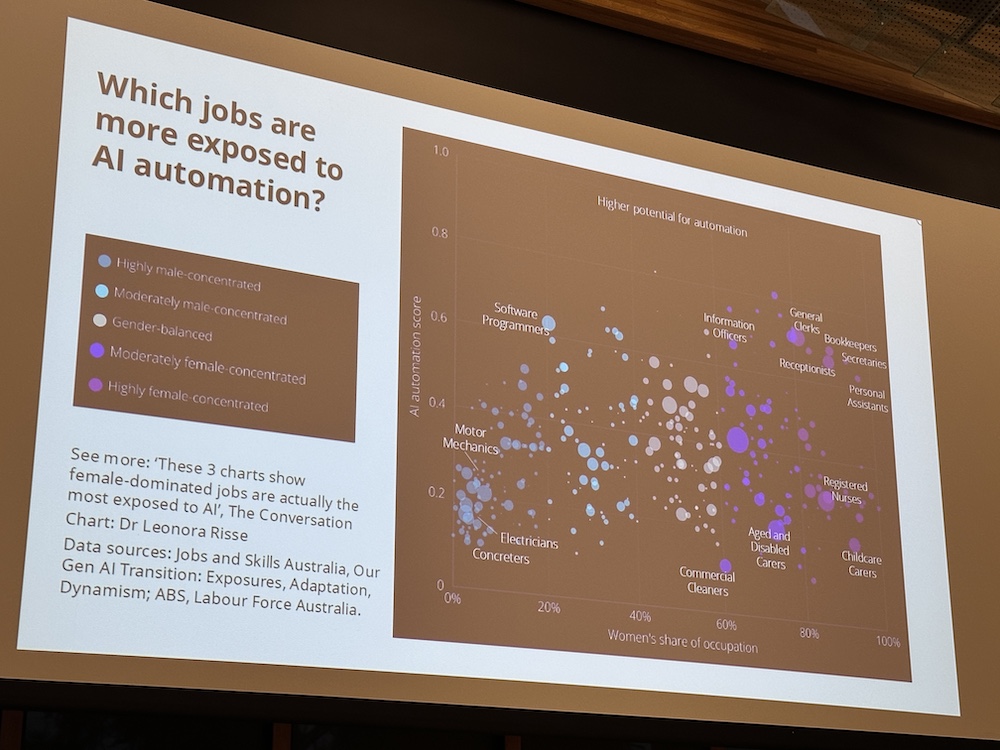
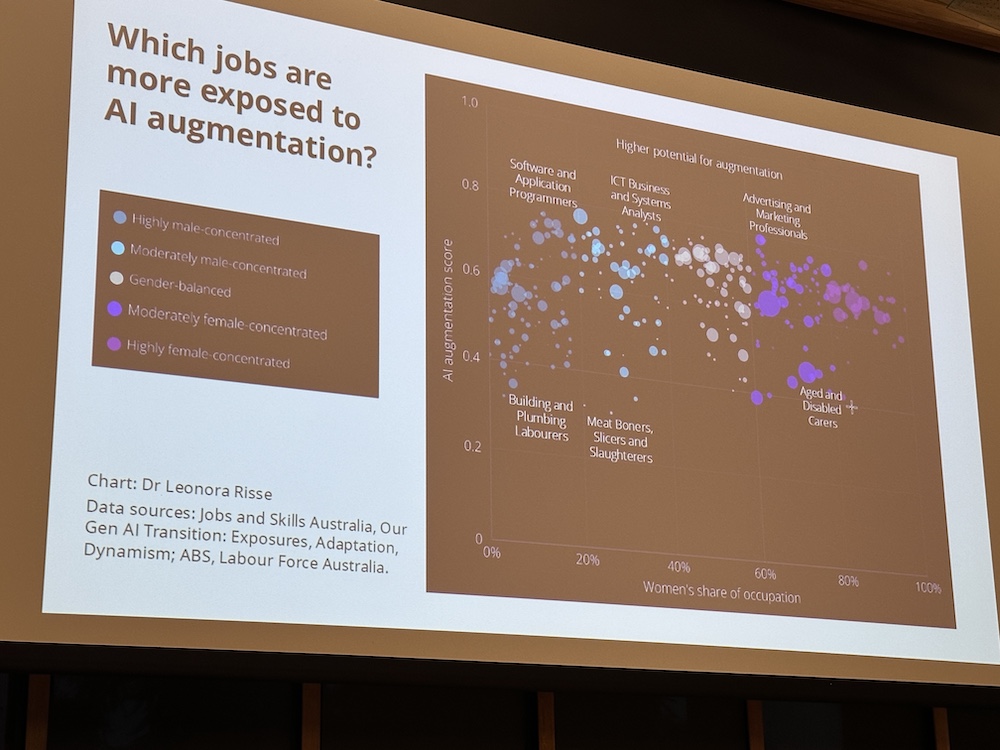
Panel: AI + Social Policy – Opportunities & Risks – Prof Edward Santow, Associate Prof Leonora Risse, and Prof Ben Edwards, with chair Prof Greg Marston
The panel opened with a mention of the famous William Gibson quote about the future not being evenly distributed, and a quote from Yuval Harari about Industrial Revolution inventions like the steam train and loom that were used by humans. The difference between those examples and now is that AI agents can make decisions. These are not tools that are passive.
It was noted that the incentives and strategies around AI matter. For example, the New South Wales (NSW) AI Assurance Framework is designed to assess risks for government departments and agencies and have things go to the oversight review committee. Going in front of that committee should be like going to the dentist and encourage people to aim to consider things with AI before they get much worse and avoid human rights harms.
Other things mentioned: We need to distinguish between AI and agentic; if AI has a mind of its own, responsibility and accountability have to be considered. We need to use a gender lens and look at the structures of power. There’s no clear sense of how productivity benefits will flow to workers or just investors/capital owners. For example, if we automate all the easy calls in customer call center and leave the human to only do the complex ones, their role could be really hard and impact their identity at work.
Edwards discussed his longitudinal study of young people using chatbots which started years ago and showed that 40% are using them for companions, so it’s a reason to look at regulation (like places such as China).
It was discussed that if you’re doing social research and haven’t considered AI important, you should; it’s having widespread and big impact. There are opportunities to use local / open-weight models and keep data in Australia or on your computer. There is a need for monitoring mechanisms from the university and research sector to have increased oversight and regulation in Australia. Australia has started doing this with social media and needs to invest in infrastructure. Also mentioned was a data donation program and a way of using AI to do cognitive testing with surveys more efficiently.
There’s a wider issue of not asking users of systems before making tech for them. For example, beeping in hospitals; they thought it would be a good idea to have beeps to notify nurses, but in actuality, nurses get used to it and if there are too many false positives, they end up ignoring them.
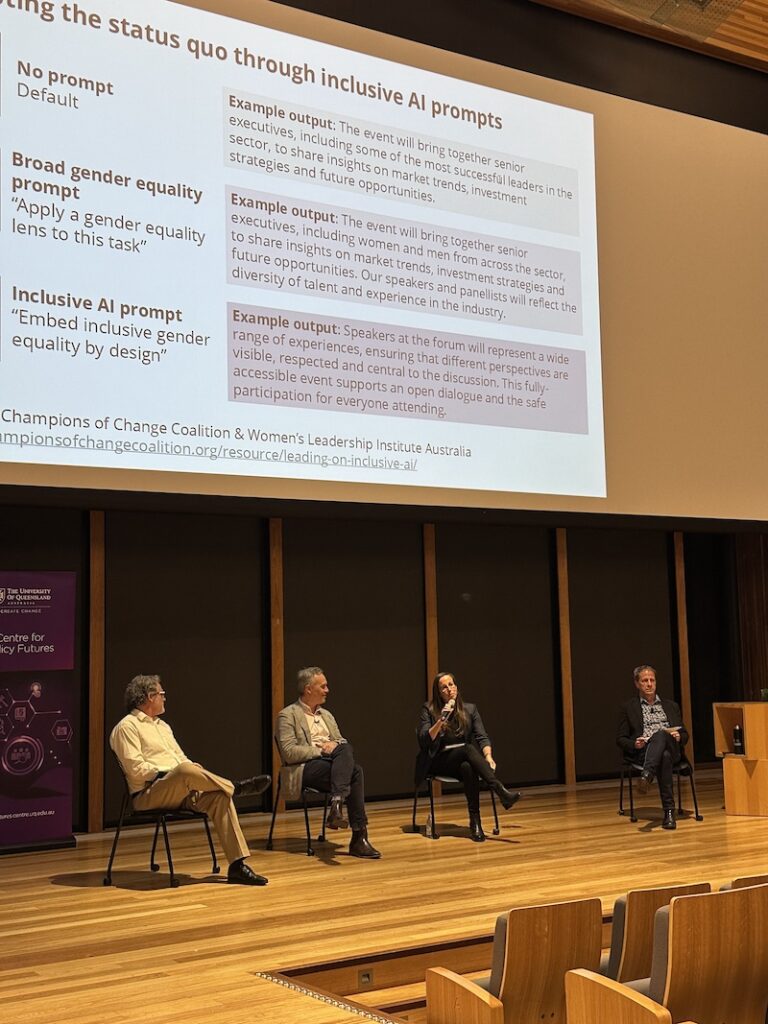
The Champions of Change Coalition and Women’s Leadership Institute Australia have inclusive AI prompts and resources to encourage the development of gender equality and inclusivity in AI.
Stream: Infrastructure & Urban Policy
Tackling the Paucity of Energy Upgrades for Renters – Jacob Priergaard (presenting), Jana Farook
Priergaard discussed efforts toward electrification and transitioning away from gas in ACT, Australia. Almost a third of Australian households are renters, meaning they could be harder hit by the move toward getting off gas as gas becomes more expensive the fewer households there are using it. One of the big questions of the day is how to navigate collective public problems in a neoliberal policy environment? (like energy transition) He noted that we are often just tinkering at the margins rather than looking at more radical or different policy solutions outside of existing neoliberal structures. The neoliberal method is steering not rowing, but since ACT already owns half of the gas network, it could buy 1% and then as the state it could manage the transition off of gas.
Panel: The Power to Persuade: getting your research noticed where it matters
This panel gave an overview of the Power to Persuade platform that was founded in 2011 and is based in Australia. It’s a blog published under a Creative Commons (CC-BY-NC-ND) license and has growing traffic from the U.S. Having good evidence and information appearing in Google is more important than ever. Since so much of academic research is trapped behind paywalls that Google and AI can’t get to and that may not be read much even in academia, this site offers a way of sharing research in a more accessible format. Blogs also allow for more flexibility in the style of writing and focus area than traditional journal articles.
An interesting point about the potential for impact is how when other groups use generative AI, it might surface your research. For example, in the case of Deloitte being found out for using AI and having hallucinations in a government-commissed report in Australia, it used a certain term that had appeared a lot online, so even though it’s not definitive that there’s a causal link, it is possible due to how generative AI chatbots can surface information. Meaning, there is more opportunity than ever to have influence by publishing in open-source sources like blogs and Power to Persuade that will be scraped and/or searched by generative AI tools.
Stream: Climate, Creativity, & Care: A Symposium on Basic Income and Contemporary Social Policy Challenges
Universalism or Participation: Australian Attitudes to Basic Income – (virtual) Ben Spies-Butcher, Troy Henderson, Roger Vincent Patulny
There has been a drop in support for Universal Basic Income (UBI) in Australia, going from 57% support in 2019 down to 43%. The new divide is between renters and mortgagees, potentially because those who have purchased a home now take into account that they have a mortgage to service and there isn’t the same concern as in Covid that they might not have employment.
Basic Income for Artists – Julian Meyrick
Despite evidence for the benefits of the arts and cultural sector, the sector is struggling. What’s happening in policy is moving from thinking about what’s possible to peddling what is plausible. Creative Australia lacks credibility and is seen as a bad actor when grant acceptance rates are so low. Meyrick’s 2017 book Theatre and Australia reviews Australian investment in the arts over decades. He has taken insights from his theatre background in considering that the more data you have, the more important it is to have a narrative around it. Tone is also important in discussing basic income initiatives, in terms of thinking about how are you going to sound (fearful, anxious, funny, hopeful) and are you speaking to the public or a government stakeholder.
The Role of UBI in Addressing the Polycrisis of Climate Change and Automation – Greg Marston
Marston discussed the need to move away from taxing labor and look at taxing carbon, since even a small percentage could raise lots of money for UBI. He noted that cognitive framing can matter more than facts.
Indigenous Conceptions of Care: Expanding Ideas of Work and Economy – Elise Klein (presenting), Zoe Staines
Klein discussed care work in relation to what is considered work and valuable.
On a question to the panel about whether AI will give everyone more leisure time or not, there was a discussion about how other forms of identity can emerge if we don’t have our identity based just on our job. We could work less but not feel worth less. But the state needs to play a larger role in front-footing risk not waiting or being reactive, although it depends how fast it all happens, and if a sense of renewed choice can be communicated.
Thanks to everyone who contributed to making the conference a valuable exchange of ideas.